

For many women, the most distressing part of living with uterine fibroids isn’t just the internal pain—it’s the external “body betrayal.” Looking in the mirror and seeing a protruding stomach that mimics a pregnancy can lead to uncomfortable questions from strangers and a deep sense of frustration when clothes no longer fit.
If you’ve struggled with a stubborn lower-abdominal bulge, realizing a medical condition is behind the change is a powerful first step. But the next question is: What does life look like on the other side of fibroid treatment?
The Silhouette Timeline: What Does a Fibroid Belly Feel Like?
Unlike the softer tissue that accumulates with weight gain, a fibroid belly often feels firm and is typically concentrated in the lower abdomen. Women frequently describe it as a hard, rounded bulge below the belly button that doesn’t change with diet or exercise.
This distinct shape is caused by uterine expansion. As uterine fibroids grow, they force the uterus to enlarge—sometimes to the size of a five-month pregnancy. This creates a firm, hard belly that presses against the abdominal wall. Seeing enlarged uterus pictures or ultrasound images often reveals how these myoma sizes (ranging from a 4 cm fibroid to a large, 10 cm “grapefruit”) physically displace other organs.
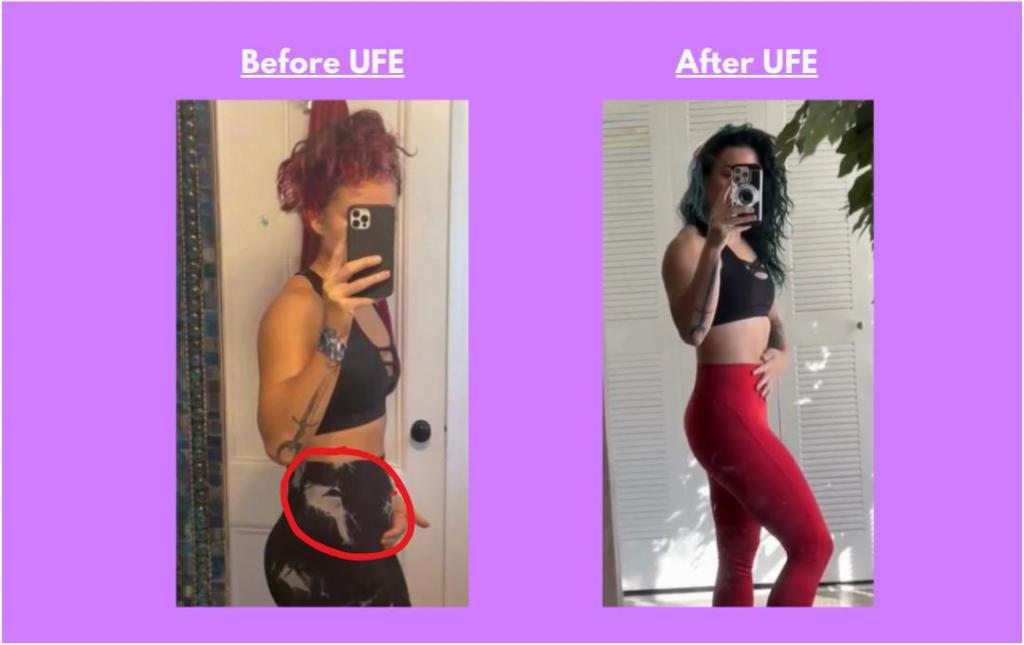
Seeing is Believing: Real Fibroid Belly Before and After Transformations
While words can describe the pressure, nothing shows the potential for relief quite like a visual, such as before-and-after pictures of a fibroid belly:
- The “Before”: You typically see a lower abdominal bulge that starts just above the pubic bone. It creates a “pooch” that remains constant regardless of the time of day or what you eat.
- The “After”: Following non-surgical fibroid treatment like Uterine Fibroid Embolization (UFE) or a myomectomy, the stomach size after fibroid removal or shrinkage changes significantly. The uterus returns to its natural position, the “pregnant look” disappears, and the physical heaviness lifts.
Cara Maria Sorbello, MTV Reality Star’s fibroid journey mirrors the experience of millions: a healthy lifestyle overshadowed by a firm, “seven-month” belly bulge. After imaging revealed the true scale of the growths, Cara Maria sought Uterine fibroid embolization (UFE)—a non-surgical path that helped her reclaim her health and her silhouette without the need for a hysterectomy.
“For years, I struggled with intense pain, heavy periods, and a bloated stomach that made me look months pregnant at times. Learning about my condition was both a relief and a wake-up call. I want to share my story to help others recognize that there are treatments, support, and most importantly, hope.” –Cynthia Bailey, Actress and USA Fibroid Centers Ambassador.
Fibroid Belly Pictures Using MRI
An MRI is one of the most effective ways to visualize fibroids without radiation exposure. Here is what to expect during the 30-minute scan:
- The Experience: You’ll lie on a motorized table; while the machine is loud, the procedure is completely non-invasive and painless.
- Precision Imaging: In some cases, a “contrast” medicine is used via IV to help the fibroids stand out more clearly against healthy tissue.
- Results: The process produces high-definition, crystal-clear images that help your specialist map out the best treatment plan for you.
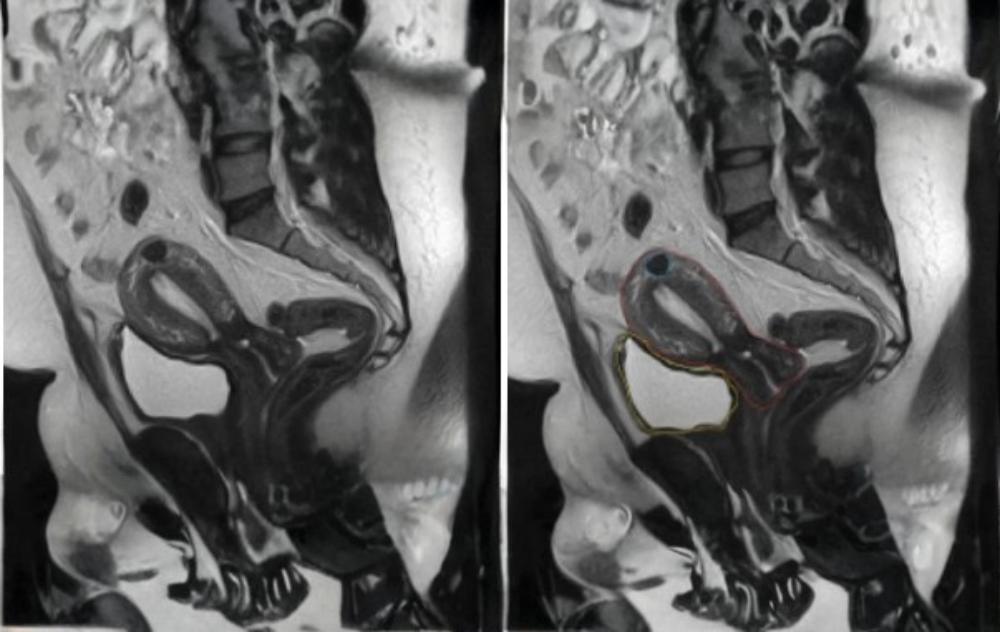
To help you navigate these images, the patient’s back is to the right, and their front is to the left.
- The Uterus (Red): The MRI offers a crystal-clear view of the uterine layers compared to a traditional ultrasound.
- The Bladder (Yellow): This sits just in front of the uterus, showing how the two structures interact.
- The Fibroid (Blue): The dark object at the top of the uterus is a small fibroid.
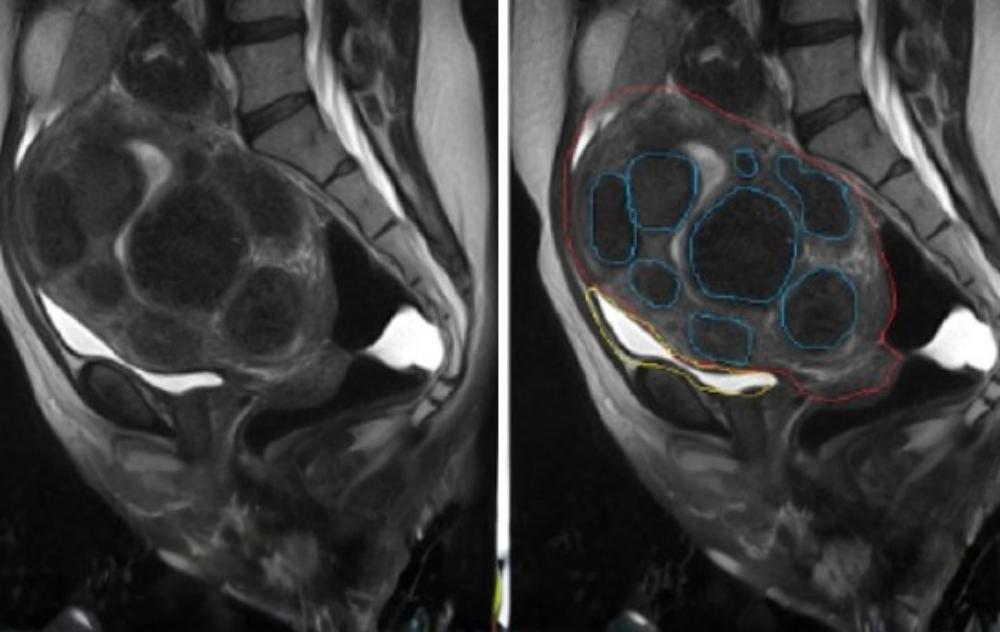
While the fibroid in this example is small, many patients deal with multiple, larger growths that significantly alter the shape of the uterus, as seen in the following scans:
From “Grapefruit” to “Walnut”: Understanding the Fibroid Size Chart
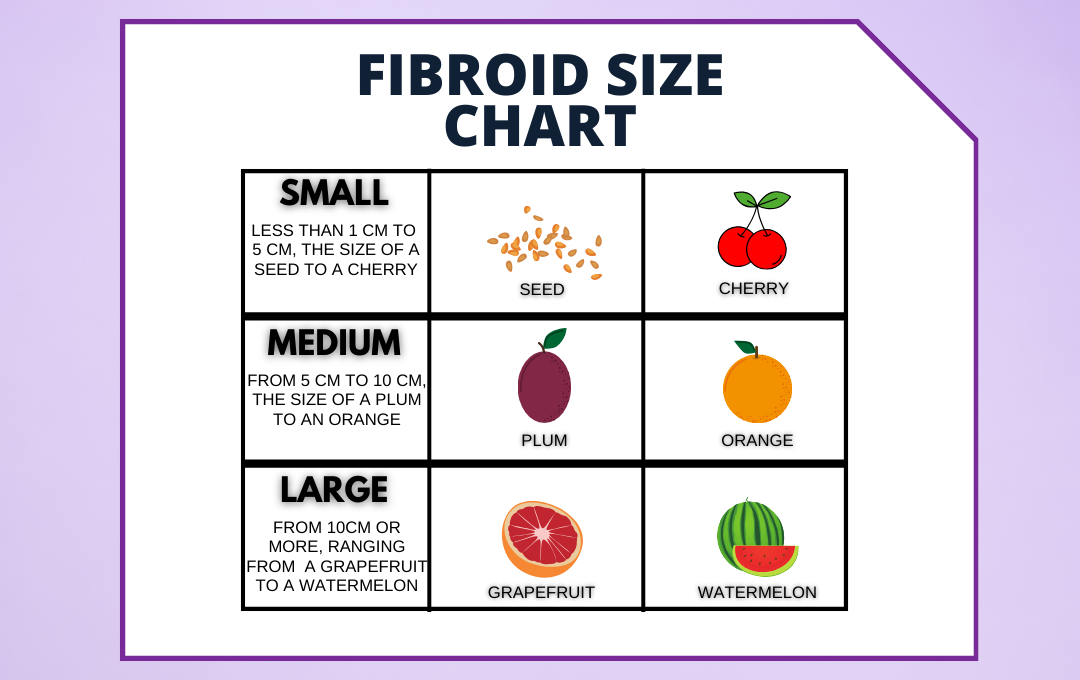
When reviewing a uterine fibroid size chart, it becomes clear why the stomach expands.
- Small (Seed to Cherry): Usually doesn’t cause a visible bulge but can cause heavy menstrual bleeding.
- Medium (Plum to Orange): Often results in a firm belly and pelvic pressure.
- Large (Grapefruit and larger): This is where the “look pregnant” belly becomes most pronounced, often causing frequent urination as the mass presses on the bladder.
Is It a Fibroid Belly, Fat, or Bloating? Three Key Differences
A key difference in the fibroid belly vs fat belly debate lies in how the abdomen feels and behaves. While abdominal fat is generally soft, a fibroid belly often feels firm, dense, or hard to the touch. That is because the protrusion is caused by the solid muscle of the fibroids and the enlarged uterus pushing forward. Also, unlike digestive bloating that can fluctuate throughout the day, a fibroid belly is typically constant.
The location of the bulge offers another strong clue. General weight gain tends to distribute more evenly across the abdomen and waist. A fibroid belly, however, is often concentrated in the lower abdomen, below the navel. This can create a distinct, localized pooch that may make you look a few months pregnant, even if the rest of your body hasn’t gained weight.
Finally, consider the full spectrum of your symptoms. A protruding stomach from weight gain isn’t linked to your menstrual cycle. In contrast, a fibroid belly frequently arrives with heavy or prolonged periods, pelvic pain or pressure, and a frequent need to urinate. While some symptoms can overlap with other conditions, such as endometriosis, this combination of a firm bulge and cycle-related issues strongly indicates fibroids.
Why Diet and Exercise Fail: Fibroid Belly vs. Fat Belly
A common point of confusion is the bloating vs. fibroids debate. Many women spend months attempting to “crunch” away a fibroid belly, only to find the bulge is unaffected.
The key difference between a fibroid belly vs fat belly is the density. Fat is compressible and distributed; a fibroid is a solid, muscular growth. This is why weight loss efforts fail to reduce the bulge—you cannot “burn off” a fibroid tumor. Whether it’s a 3 cm fibroid causing localized pressure or a 5 cm fibroid causing a visible shift, medical intervention is the only way to “evict” the growth and flatten the abdomen.
I had fibroids for a while, but over time, they grew extremely large–three in particular were the size of a small melon, an orange and a plum. My bloating has significantly decreased, all in three weeks! I can’t wait to see the full results in the coming months.”–USA Fibroid Centers’ Patient.
Uterine Fibroids: More Than Just a “Belly Bulge”
While a protruding stomach is the most visible sign of an enlarged uterus, it is rarely the only symptom. Fibroids are the culprits behind a wide range of physical and emotional disruptions. Depending on the location, size, and number of growths, you may also experience:
- Heavy or prolonged periods are among the most common signs. If your periods last longer than a week or involve heavy bleeding and clots, it’s a major red flag.
- Anemia and Fatigue: Over time, heavy blood loss can lead to iron deficiency (anemia), leaving you feeling constantly exhausted and weak.
- Pelvic Pain and Pressure: Beyond the bulge, many women feel a persistent, heavy ache in the pelvic region.
- Frequent Urination: When a large fibroid presses against your bladder, it can cause a constant, urgent need to go—even in the middle of the night.
- Lower Back and Leg Pain: Large growths can compress nearby nerves, causing “referred pain” that radiates into the lower back or down the legs.
- Constipation: Fibroids pressing against the bowel can disrupt your digestive system, leading to chronic constipation.
- Painful Intercourse: Depending on their position, fibroids can make intimacy uncomfortable or even painful.
Are you still not sure if it’s a fibroid belly? If you’re checking off more than a few symptoms on this list, it’s time for answers. Take our quick, confidential Symptom Checker to see if your “bloating” is actually a sign of uterine fibroids.
How to Get Rid of Fibroid Belly: Your Transformation Options
You don’t have to settle for an enlarged uterus. Today, there are alternative paths to a flatter stomach without a hysterectomy.
- Uterine Fibroid Embolization (UFE): This non-surgical fibroid treatment blocks the blood supply to the growths. Over weeks and months, the fibroids shrink (like a grape turning into a raisin), and the fibroid belly bulge gradually diminishes.
- Myomectomy: A surgical procedure to remove uterine fibroids. While it provides an immediate change in stomach size, it requires a recovery period after fibroid removal.
Start Your Transformation at USA Fibroid Centers
At USA Fibroid Centers, we specialize in Uterine Fibroid Embolization (UFE)—the gold standard in non-surgical fibroid care. Our highly skilled interventional radiologists use advanced image-guided technology to treat fibroids without a single stitch.
By choosing UFE, you can avoid the risks of major surgery and a long hospital stay. Most patients return to their normal lives within one to two weeks, watching as their symptoms disappear and their “fibroid belly” gradually diminishes. We are dedicated to helping you move from your “before” to your “after” with compassion and expertise.
My quality of life is so much better now after my [UFE] procedure. I now have zerios symptoms, my mood has improved and even my heavy bleeding is gone. My bloating has come down..no more looking bloated and sick!”– USA Fibroid Centers’ Success Story.
Ready to reclaim your body and your health? Don’t let fibroids stay in control. Schedule a consultation with one of our specialists today to determine whether UFE is the right path for your transformation.
FAQ’s
Can fibroids make your stomach big?
As fibroids grow, they act as a “space-occupying mass.” Because the uterus is a muscular organ, it expands to accommodate these growths. Large or multiple fibroids can cause the uterus to stretch to the size of a second-trimester pregnancy, leading to a visible protrusion often called a “fibroid belly
What does a fibroid belly look like?
A fibroid belly typically appears as a localized bulge in the lower abdomen, between the pubic bone and the navel. Unlike general weight gain, it often looks like a “pooch” or a “pregnancy bump” that remains constant and doesn’t disappear with weight loss or changes in diet.
What do uterine fibroids look like?
Internally, uterine fibroids are dense, white, circular masses of muscular tissue. They can range in size from a tiny “poppy seed” to a large “grapefruit” or even a “melon.” On an MRI scan, they typically appear as dark, well-defined round objects within or on the walls of the uterus.