


Medically reviewed by
Dr. Jacob White, M.D.
Interventional Radiology | Reviewed: November 2026
Look for a physician who specializes in fibroid treatment, has significant UFE case volume, offers comprehensive pre-procedure imaging, and provides follow-up care through recovery. Knowing what credentials, experience, and questions actually matter helps you evaluate your options clearly.
Uterine Fibroid Embolization (UFE) – also known as Uterine Artery Embolization (UAE) – is a minimally invasive, non-surgical procedure for uterine fibroids. The physician who performs it should have deep, focused experience with this specific treatment, whether their background is in interventional radiology, vascular surgery, or another specialty that encompasses image-guided embolization. This guide walks through each factor worth considering before you schedule your consultation.
What Is a UFE Specialist, and Why Does Specialization Matter?
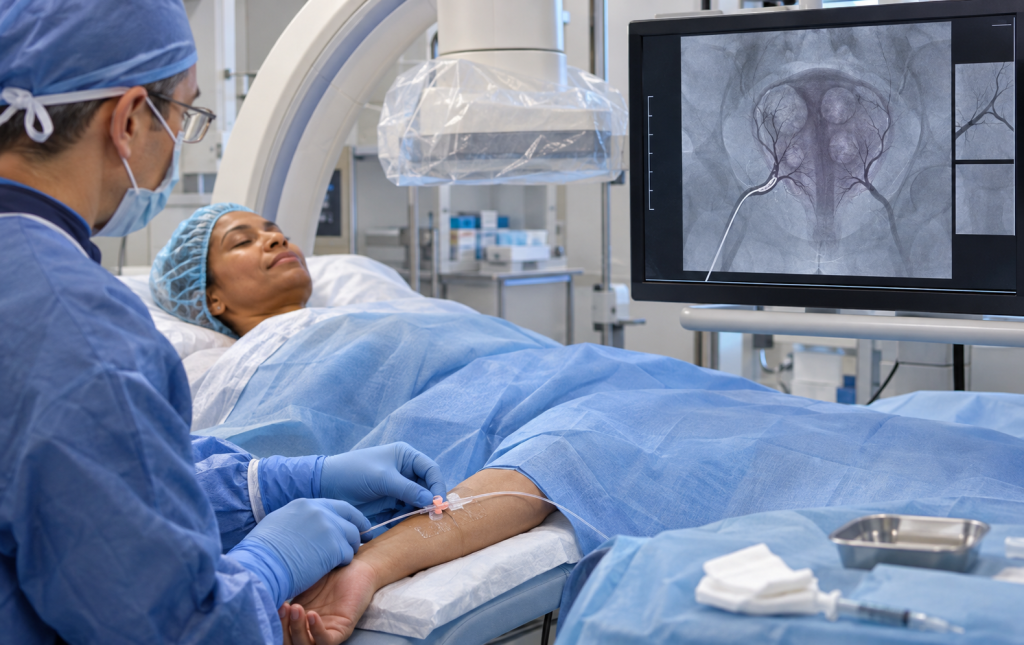
A UFE specialist is a physician with advanced training in image-guided, minimally invasive vascular procedures. UFE works by guiding a thin catheter through a small access point – usually at the wrist or groin – into the arteries that supply blood to your fibroids. Tiny embolic particles are then delivered to block that blood flow, which causes fibroids to gradually shrink.
Physicians who perform UFE typically come from backgrounds in interventional radiology or vascular surgery, both of which involve extensive training in catheter-based, image-guided techniques. What matters most is not the specific specialty title but the physician’s focused experience with fibroid embolization – how often they perform it, what their outcomes look like, and whether they offer end-to-end fibroid care.
Because UFE requires precise navigation of the uterine arteries, it is not a procedure performed by gynecologists. OB-GYNs are typically the first point of contact for fibroid diagnosis and can offer medical care, but they refer patients to a physician with vascular training when UFE is a consideration. See our overview of OB-GYN vs. fibroid specialist care for a detailed comparison of these two specialties.
You may also see UFE referred to as Uterine Artery Embolization (UAE). Both terms describe the same procedure. UAE is the older clinical term; UFE became the more common patient-facing name because it identifies both the condition being treated and the technique used.
What to Look for in a UFE Specialist’s Background
Specialized Training in Image-Guided Fibroid Treatment
UFE is a catheter-based, image-guided procedure that requires specific training in endovascular techniques. Physicians who perform it typically complete advanced fellowships or residency training in interventional radiology or vascular surgery, both of which involve extensive hands-on work with catheter navigation, embolic agents, and vascular anatomy.
The specialty credential matters less than whether the physician has completed training that specifically covers image-guided embolization. When evaluating a provider, look for evidence of this focused training in their background – whether that is listed on their practice profile, confirmed by the treatment center, or explained directly during consultation.
A Practice Focused on Fibroid Patients
Physicians who perform many different minimally invasive procedures may include UFE only occasionally. A provider who regularly evaluates and treats women with symptomatic fibroids is more likely to have deep familiarity with fibroid anatomy, treatment planning, and the range of presentations they may encounter – including patients with large or multiple fibroids, those with fertility considerations, and those weighing UFE against other options.
If you are unsure how a physician is categorized, our article on what a fibroid doctor is called explains the differences between specialist types and their training backgrounds.
A Comprehensive Approach to Care
Strong UFE specialists do more than perform the procedure itself. They review imaging in detail before making a treatment recommendation, walk through expected outcomes and recovery, and provide follow-up imaging after treatment. Look for a provider who treats the consultation as an opportunity to fully understand your situation – not simply to confirm candidacy.
Experience and Case Volume: Why UFE-Specific Numbers Matter
General vascular experience is not the same as UFE-specific experience. Fibroid embolization involves navigating uterine artery anatomy that varies significantly from patient to patient, and that variation is something a physician learns to handle through consistent, focused practice.
When evaluating a specialist, the number of UFE procedures they have performed is a more meaningful signal than general embolization case volume. A physician who regularly performs UFE has encountered a wider range of fibroid presentations – including complex cases involving multiple or large fibroids – and has refined both their technique and their approach to patient selection.
Questions Worth Asking About Volume and Approach
During your consultation, it is entirely appropriate to ask how many UFE procedures the physician performs per year and what outcomes they typically see in terms of symptom improvement and fibroid reduction. A physician with strong UFE experience will answer this directly.
You may also ask whether they offer radial artery access through the wrist, in addition to the more traditional femoral access through the groin. Radial access can mean less discomfort and quicker mobilization after the procedure. Not every patient is a candidate, but a physician with experience in both approaches can explain which is more appropriate for your anatomy.
What a Dedicated Fibroid Center Offers
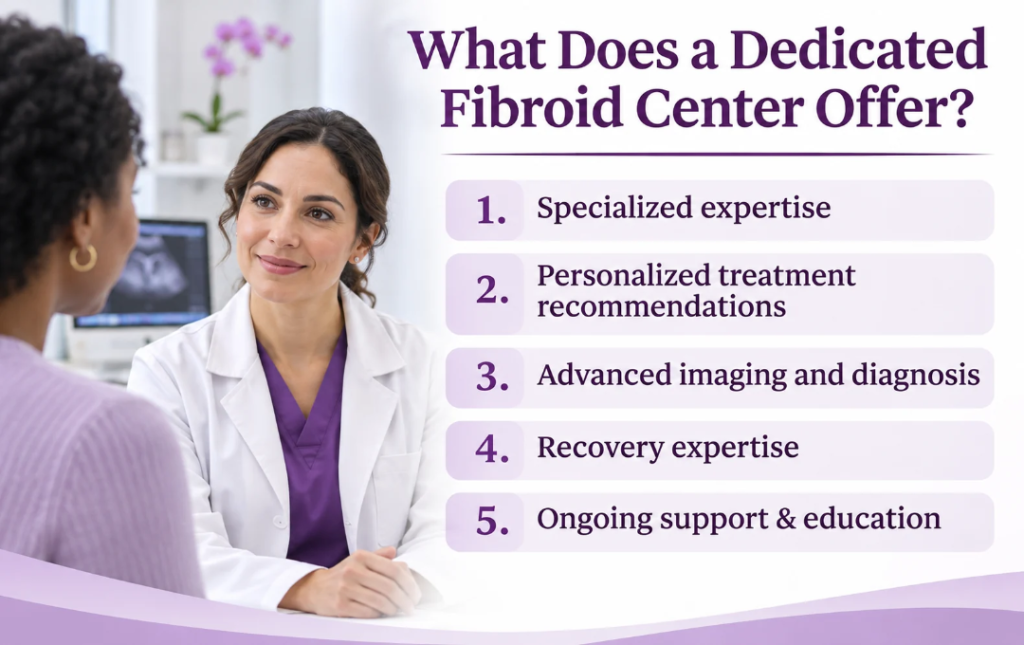
Where a specialist practices can be as important as their individual credentials. Centers that focus on fibroid care are built to support the full treatment experience – before, during, and after the procedure.
Coordinated Pre-Procedure Imaging
A center committed to fibroid care typically coordinates the imaging needed to evaluate your situation before recommending treatment. This generally includes pelvic ultrasound and, in many cases, MRI. Imaging confirms fibroid size, number, and location – all factors that affect whether UFE is appropriate and how the procedure should be planned. If a center expects you to arrange imaging on your own with no guidance, that is worth noting.
Learn more about what fibroid imaging involves on our uterine fibroid diagnosis page.
A Thorough Candidacy Evaluation
UFE is not suitable for every fibroid presentation. Active pelvic infection, pregnancy, and certain uterine conditions are contraindications. The size, number, and location of fibroids also factor into whether UFE is likely to produce meaningful relief. A thorough candidacy evaluation – reviewing your symptoms, imaging, reproductive goals, and overall health – should happen before any recommendation is made, not after.
Learn more about whether you may be a candidate for UFE and what that evaluation involves.
Follow-Up Care That Does Not Require a Separate Provider
Post-procedure follow-up is a meaningful part of outcomes. Expect imaging at some point in the months following UFE – often within three to six months – to confirm fibroid shrinkage and symptom improvement. A center with integrated follow-up care means that monitoring is handled by the same team, and you have a clear point of contact if anything comes up during recovery.
Wondering if UFE is available near you? Find the location closest to you.
Questions to Ask During Your Consultation
A consultation is your opportunity to assess both a physician’s expertise and how clearly they communicate. These questions can help you gather what you need to make a confident decision.
How many UFE procedures do you perform per year, and what do your typical outcomes look like?
This tells you about procedural volume and experience depth. Ask specifically about outcomes for patients with fibroids similar in size or number to yours.
What imaging will I need before you can evaluate my candidacy?
A thorough answer explains what imaging is needed and whether the center coordinates it or expects you to bring it from elsewhere.
Will you personally perform the procedure, and will you manage my follow-up?
In some practices, the consulting physician is not the one who performs the procedure. Continuity from evaluation through recovery is worth asking about directly.
What does recovery typically look like for someone with my situation?
Recovery can vary based on fibroid characteristics, the access approach used, and individual factors. A specific answer is a better sign than a generic one.
What are my options if UFE turns out not to be right for me?
An experienced specialist can explain what alternatives are available if candidacy is not confirmed, without making you feel pressured toward a particular path.
Taking the Next Step Toward a Consultation
You do not need a referral to schedule a consultation with a fibroid specialist, though coordinating with your existing provider can be helpful. Many patients seek out a fibroid specialist specifically because they want to understand non-surgical options or get a second opinion before making a decision.
If symptoms – including heavy menstrual bleeding, pelvic pressure, frequent urination, or anemia related to blood loss – are affecting your daily life, a consultation gives a specialist the opportunity to review your imaging and walk through whether UFE may be a reasonable path forward. The consultation is an evaluation, not a commitment.
Treatment option: UFE
Take the Next Step Toward Non-Surgical Fibroid Care
Knowing what to look for in a UFE specialist puts you in a stronger position when you sit down for that first consultation. At USA Fibroid Centers, our physicians specialize in minimally invasive fibroid treatment, with imaging, candidacy evaluation, and follow-up care all coordinated in one place.
Our specialists can review your fibroids, explain your options, and help you understand whether UFE may be right for your situation – with no pressure and no surgery required to explore it.
FAQs About Choosing a UFE Specialist
- Society of Interventional Radiology. “Uterine Fibroid Embolization (UFE).” sirweb.org/patients/uterine-fibroids/
- American College of Radiology. “Interventional Radiology.” acr.org
- Office on Women’s Health, U.S. Department of Health and Human Services. “Uterine Fibroids.” womenshealth.gov/a-z-topics/uterine-fibroids
- National Institute of Environmental Health Sciences (NIEHS). “Uterine Fibroids.” niehs.nih.gov/health/topics/conditions/uterine-fibroids
Medical disclaimer: This article provides educational information about uterine fibroids and treatment options. It is not a diagnosis or medical advice. Only a qualified fibroid specialist can determine whether you have fibroids or recommend appropriate treatment. If you have heavy periods, pelvic pain, or other symptoms, consult a healthcare provider or contact USA Fibroid Centers for an evaluation.