
Medically reviewed by
USA Fibroid Centers Medical Review Team
Experienced interventional radiology specialists
Choosing between a hysterectomy and Uterine Fibroid Embolization (UFE) means weighing two fundamentally different approaches to fibroid relief. A hysterectomy is a surgical procedure that removes the uterus entirely, ending fibroid symptoms for good but also ending fertility and requiring a recovery of four to eight weeks. UFE is a non-surgical, image-guided procedure that shrinks fibroids by cutting off their blood supply, preserving the uterus and typically allowing a return to normal activities within one to two weeks. Despite UFE being available for decades, many women are still told that hysterectomy is their only option. This guide walks through how the two procedures actually compare across recovery, fertility, risk, cost, and long-term outcomes, so you can have a more informed conversation with a specialist before committing to major surgery.
Quick facts
- Approximately 90 percent of UFE patients experience reduced bulk symptoms, and more than 90 percent experience cessation of abnormal uterine bleeding.[1]
- About two-thirds of women who undergo UFE avoid a secondary hysterectomy over a 10-year follow-up period.[2]
- Most UFE patients return to normal activities within one to two weeks, compared to four to eight weeks after hysterectomy.[1]
What Is a Hysterectomy for Uterine Fibroids?
A hysterectomy is a surgical procedure that removes part or all of the uterus. Because the uterus is gone, fibroids cannot grow back, which is why this procedure has long been described as a definitive solution for fibroid symptoms. It is a major operation, however, performed under general anesthesia and typically requiring a hospital stay.
Types of Hysterectomy Used for Fibroid Treatment
- Abdominal hysterectomy: Performed through an incision in the abdomen. Generally has the longest recovery, often six to eight weeks.
- Vaginal hysterectomy: Performed through the vaginal canal without an abdominal incision. Recovery is typically shorter than an abdominal approach.
- Laparoscopic hysterectomy: Performed using small incisions and a camera-guided instrument. Often has a faster recovery than abdominal surgery, though it is still a major procedure.
A hysterectomy can be partial, removing only the uterus (supracervical), or total, removing both the uterus and cervix. Some hysterectomies also remove the ovaries and fallopian tubes, which can trigger early menopause and related symptoms such as hot flashes, night sweats, and vaginal dryness. A gynecologic surgeon can walk you through which type may apply to your situation. If you are exploring options before committing to surgery, our comparison of UFE versus fibroid surgery may help you understand the non-surgical alternative first.
Hysterectomy Risks and Recovery
Because a hysterectomy is major abdominal or pelvic surgery, it carries the risks typical of any major operation, along with some effects specific to removing the uterus:
- Surgical risks: Infection, heavy bleeding, anesthesia complications, and potential damage to nearby organs such as the bladder or intestines.
- Hormonal effects: If the ovaries are removed, sudden menopause can follow, sometimes requiring hormone replacement therapy, which carries its own considerations.
- Recovery time: Typically four to eight weeks, with restrictions on lifting, exercise, and driving during that window. Most women experience vaginal bleeding or discharge for up to six weeks after the procedure.
- Pelvic floor changes: Because the uterus helps hold the bladder and bowel in place, some women experience an increased risk of pelvic floor disorders, including prolapse or urinary incontinence, after hysterectomy.
- Emotional impact: Some women experience feelings of loss, changes in body image, or emotional distress after losing the uterus, particularly if they had hoped to have children in the future. These feelings are valid and worth discussing with a healthcare provider.
- Fertility loss: A hysterectomy permanently ends the ability to carry a pregnancy.
What Is Uterine Fibroid Embolization (UFE)?
Uterine fibroid embolization, also called uterine artery embolization (UAE), is a minimally invasive, image-guided procedure that treats fibroids without removing the uterus. An interventional radiologist makes a small incision, typically in the wrist or groin, and guides a thin catheter into the arteries that supply blood to the fibroids. Tiny particles are then released to block that blood flow. Without a blood supply, the fibroids gradually shrink and soften over the following months.
UFE is performed on an outpatient basis with a light sedative rather than general anesthesia, and most patients go home the same day. Because the uterus remains in place, some women who undergo UFE are able to become pregnant afterward, though UFE is not specifically recommended as a fertility treatment and outcomes vary by individual case.
UFE Recovery and What to Expect
Because UFE does not involve surgical incisions beyond the small catheter entry point, recovery tends to be considerably shorter than hysterectomy. Most patients experience some cramping and flu-like symptoms for the first few days, often manageable with over-the-counter pain medication, before returning to light activity within about a week and full normal activity within one to two weeks. There is little risk of the infection or hemorrhaging associated with surgical procedures, and because the uterus and surrounding organs are not disturbed, there is minimal impact on hormone levels, bladder function, or pelvic floor support.
How UFE and Hysterectomy Differ
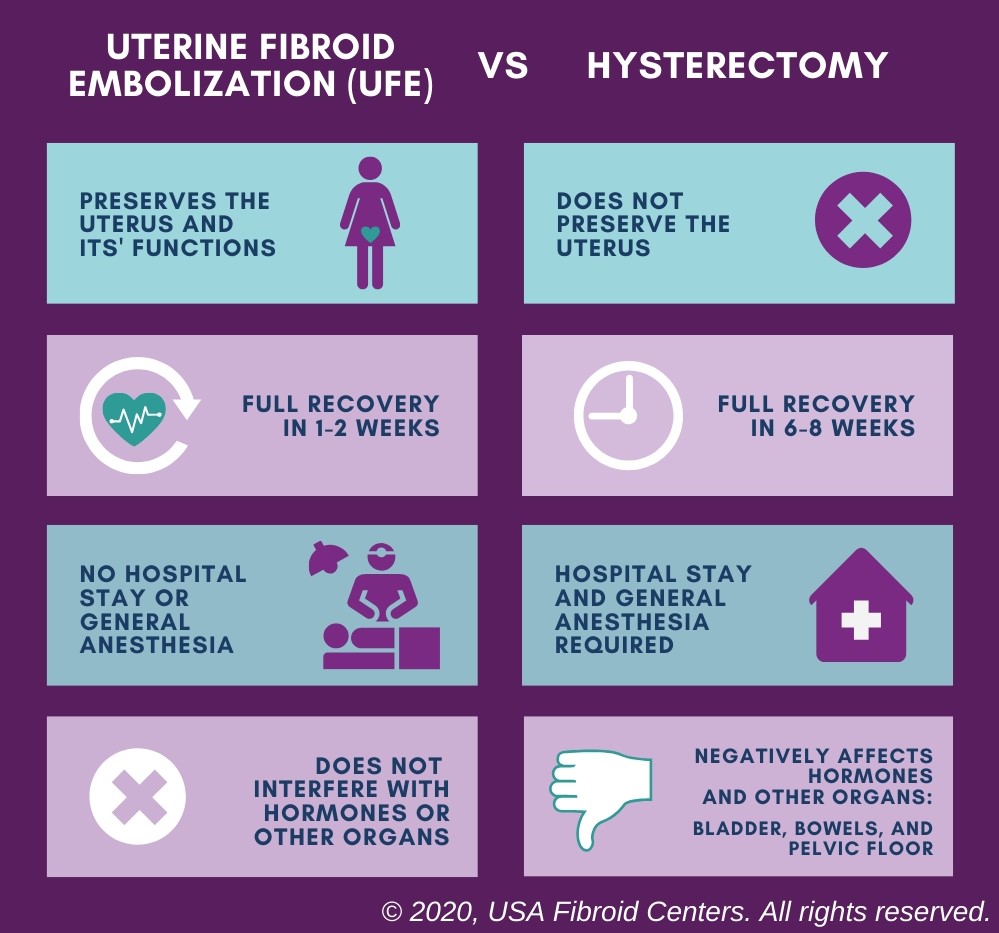
The table below summarizes the core differences between the two procedures across the factors patients most often ask about.
| Factor | UFE | Hysterectomy |
|---|---|---|
| Procedure type | Non-surgical, image-guided | Major surgery |
| Anesthesia | Light sedation | General anesthesia |
| Hospital stay | Outpatient, same-day discharge | Typically requires an overnight stay or longer |
| Recovery time | 1-2 weeks | 4-8 weeks |
| Uterus preserved | Yes | No |
| Fertility preserved | Possible for some patients | No |
| Fibroids can return | New fibroids possible over time | Not possible (uterus removed) |
| Menstruation | Continues | Ends |
| Scarring | Minimal (small catheter site) | Visible incision scarring possible |
| Major surgical risk | Lower | Higher |
| Long-term reintervention rate | About one-third at 10 years[2] | Not applicable |
Recovery Time: UFE vs. Hysterectomy
Recovery is one of the most noticeable differences between the two approaches. Most UFE patients return to light activity within about a week and to full normal activity within one to two weeks.[1] Hysterectomy recovery generally takes four to eight weeks, depending on the surgical approach, with restrictions on lifting and exercise during that time. Women who have a laparoscopic hysterectomy tend to recover faster than those who have an abdominal hysterectomy, but both are still substantially longer than UFE recovery.
Fertility and Uterus Preservation After Fibroid Treatment
UFE leaves the uterus intact, which means the anatomical possibility of pregnancy remains for some patients. Hysterectomy ends the ability to carry a pregnancy, since the uterus is removed. For women who have not completed childbearing, this is often the single most significant factor in the decision. It is worth noting that UFE is not specifically recommended as a fertility-preservation treatment; for women whose primary goal is future pregnancy, a myomectomy, which surgically removes fibroids while preserving the uterus, is sometimes discussed as an alternative worth exploring with a specialist.
Anesthesia, Hospital Stay, and Surgical Risk Comparison
UFE is performed with a light sedative and does not require an overnight hospital stay in most cases, since it avoids the incisions and tissue trauma associated with major surgery. Hysterectomy requires general anesthesia and typically at least one night of hospital monitoring, sometimes longer depending on the surgical approach and whether complications arise. UFE is associated with a lower risk of infection, blood transfusion, and the complications that can come with major surgery, though minor complications and the possibility of needing an additional procedure are somewhat more common with UFE than with surgery. In women older than 45, embolization has also been associated with a reduced likelihood of ovarian function afterward in some cases, which is a consideration your specialist can review with you individually.[1]
Cost and Insurance Considerations
Both procedures are typically covered by insurance, including Medicare, when they are considered medically necessary for symptomatic fibroids. Because UFE is an outpatient procedure that avoids a multi-day hospital stay, it can carry a lower overall cost than hysterectomy in many cases, though your specific costs depend on your insurance plan, deductible, and provider network. Reviewing your insurance coverage before your consultation can help you understand what to expect financially from either option. We encourage our patients to ask questions about their insurance coverage, self-pay or financing options so they can ease the worry of cost and focus on making the right treatment choice to help them find relief.
If you are trying to weigh these trade-offs for your own situation, learning whether you may be a candidate for UFE is a reasonable next step before deciding on surgery.
Ready to explore whether UFE is right for you? Speaking with a specialist can help clarify your options.
Long-Term Outcomes: UFE vs. Hysterectomy
UFE remains far less common than surgery, even though it offers a non-surgical path to fibroid relief. Nationally, hysterectomy still accounts for roughly three out of every four fibroid procedures, while UFE accounts for only about 4 percent, largely because many patients and referring physicians are simply not aware it exists as an option.
Long-term outcomes support UFE as a durable choice for many women. About two-thirds of women who choose UFE avoid a secondary hysterectomy even a full decade later, and quality of life tends to remain comparable between women who choose UFE and those who choose hysterectomy over that same period. UFE patients also tend to leave the hospital sooner and return to routine activities faster than hysterectomy patients, without a meaningful difference in overall complication rates.[3]
Can Fibroids Return After UFE?
This is one of the most important questions to ask before choosing between the two treatments, and the honest answer is that it depends. UFE treats the fibroids that are present at the time of the procedure, but it does not change the underlying tendency to develop fibroids. New fibroids can develop from tissue that was too small to detect during the original procedure, and about one in three women who choose UFE eventually need further treatment over the following decade, most often due to persistent or recurring symptoms.[2]
Because a hysterectomy removes the uterus entirely, fibroids cannot return after that procedure. This is the primary reason hysterectomy is often positioned as a definitive option for fibroid symptoms, though that finality comes with the surgical trade-offs described above. If ongoing symptom management with the possibility of retreatment is acceptable to you in exchange for a shorter recovery and preserved fertility, UFE may be worth discussing with a fibroid specialist. If new fibroids do develop, UFE can typically be repeated, which is one of the procedure’s advantages over a one-time surgical solution. Learning what ongoing care after UFE looks like can help set expectations either way.
Are You a Candidate for UFE Instead of a Hysterectomy?
Not every patient with fibroids is an ideal candidate for embolization, and a hysterectomy is not automatically the right choice for every patient either. Fibroid size, number, and location, along with your age, symptom severity, and fertility goals, all factor into which option may be more appropriate. Larger or more numerous fibroids, or fibroids in certain locations within the uterus, may respond differently to embolization than smaller, more isolated fibroids. Uterine fibroid embolization is worth exploring for many women before committing to a hysterectomy, but a consultation with a fibroid specialist is the only way to know which approach fits your individual case.
Ready to explore whether UFE is right for you? Speaking with a specialist can help clarify your options without pressure to choose surgery first.
Considering Your Fibroid Treatment Options?
Choosing between UFE and hysterectomy is a personal decision that depends on your symptoms, your fertility goals, and how you weigh recovery time against permanence. USA Fibroid Centers offers consultations at convenient locations nationwide to help you understand whether UFE may be appropriate for your situation, and our team can also discuss insurance coverage for the procedure.
FAQs About UFE and Hysterectomy
- Uterine Fibroid Embolization. StatPearls [Internet]. National Center for Biotechnology Information, National Library of Medicine. NBK519016
- de Bruijn AM, Ankum WM, Reekers JA, et al. Uterine artery embolization vs hysterectomy in the treatment of symptomatic uterine fibroids: 10-year outcomes from the randomized EMMY trial. American Journal of Obstetrics and Gynecology. 2016;215(6):745.e1-745.e12. PubMed
- Hehenkamp WJ, Volkers NA, Donderwinkel PF, et al. Uterine artery embolization versus hysterectomy in the treatment of symptomatic uterine fibroids (EMMY trial): peri- and postprocedural results from a randomized controlled trial. American Journal of Obstetrics and Gynecology. 2005;193(5):1618-1629. PubMed
- Elhakim T, et al. Disparities in Utilization of Uterine Fibroid Embolization. JAMA Network Open. 2025. PMC12441870
Medical Disclaimer: This article provides educational information about uterine fibroids and treatment options. It is not a diagnosis or medical advice. Only a qualified fibroid specialist can determine whether you have fibroids or recommend appropriate treatment. If you have heavy periods, pelvic pain, or other symptoms, consult a healthcare provider or contact USA Fibroid Centers for an evaluation.