

Medically reviewed by
Dr. Jacob White, MD, Interventional Radiologist, Fibroid Specialist and Medical Director
Reviewed: November 2026
Patients considering Uterine Fibroid Embolization (UFE) may not realize that the procedure can be done through either the wrist or the groin. The catheter is threaded through an artery to reach the uterine arteries, and the choice of entry point depends on the patient’s anatomy, medical history, and the interventional radiologist’s recommendation. Both routes allow the physician to deliver tiny particles that block blood flow to the fibroids, which causes them to shrink over time and can relieve symptoms such as heavy bleeding, pelvic pressure, frequent urination, and abdominal discomfort. The routes differ mainly in catheter placement, the risk of access-site complications, and early recovery, so understanding those differences can help patients prepare for a conversation with their provider.
How Does Uterine Fibroid Embolization Work?
UFE is an image-guided procedure performed by a fibroid specialist, interventional radiologist or vascular specialist. Instead of surgically removing fibroids, the physician uses a thin, flexible tube called a catheter to reach the uterine arteries.
Using real-time X-ray imaging, the physician guides the catheter through the blood vessels toward the uterine arteries. Tiny particles, known as embolic agents, are then released into the arteries supplying the fibroids. These particles reduce or block the fibroids’ blood supply, causing them to shrink over time.
As fibroids become smaller, many patients experience improvement in symptoms such as heavy periods, pelvic discomfort, and pressure on nearby organs.
The catheter can enter the bloodstream through either the radial artery in the wrist or the femoral artery in the groin. The treatment itself remains the same regardless of the entry point.
What Is Wrist Access for UFE?
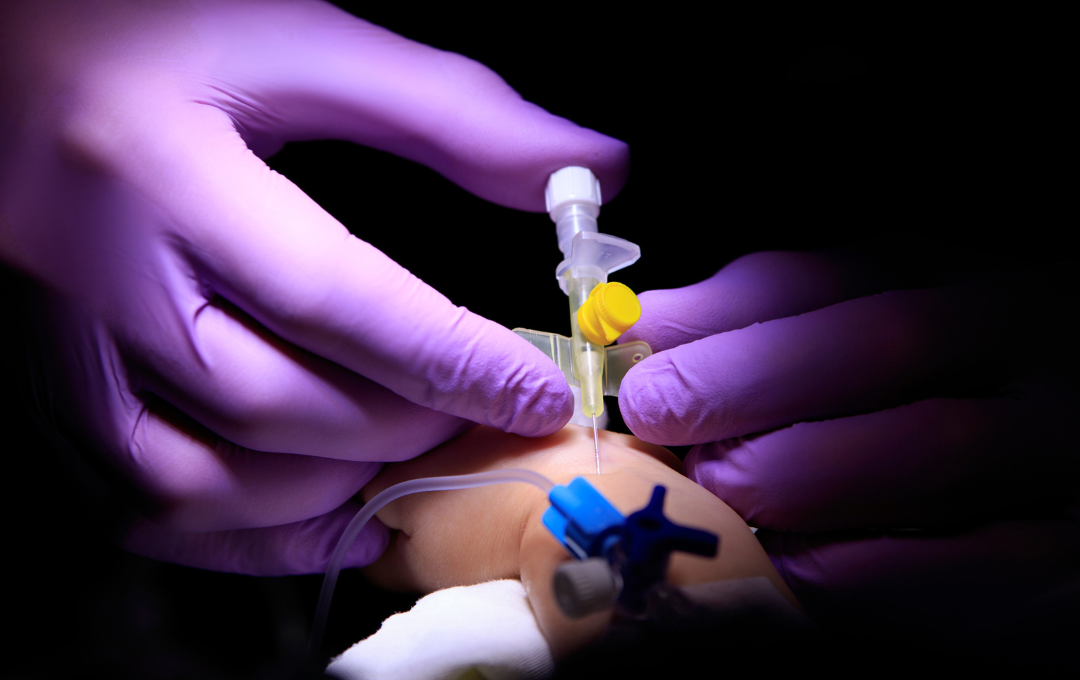
Wrist access, also called transradial access, involves inserting the catheter through the radial artery, a blood vessel located near the thumb side of the wrist.
The procedure generally involves:
- Cleaning and sterilizing the wrist area.
- Administering local anesthetic to numb the insertion site.
- Making a small puncture to access the radial artery.
- Guiding the catheter toward the uterine arteries using X-ray imaging.
- Delivering embolic particles to reduce the blood supply to fibroids.
- Removing the catheter and applying a compression band to prevent bleeding.
One potential advantage of wrist access is that patients generally do not need to keep their legs straight for an extended period after the procedure. Depending on the recovery protocol, they may be able to sit up and walk sooner.
Wrist access may also reduce certain complications associated with groin access, particularly bleeding and hematoma formation. However, it is not appropriate for every patient.
What Is Groin Access for UFE?
Groin access, also called transfemoral access, involves inserting the catheter through the femoral artery in the upper thigh near the groin.
This is an established approach used in many catheter-based procedures, including UFE.
The process generally involves:
- Cleaning and sterilizing the groin area.
- Administering local anesthetic to numb the insertion site.
- Making a small puncture to access the femoral artery.
- Guiding the catheter through the blood vessels toward the uterine arteries.
- Delivering embolic particles to block the blood supply to fibroids.
- Removing the catheter and applying pressure or a closure device to prevent bleeding.
Because the femoral artery is larger than the radial artery, it can accommodate a range of catheter sizes and devices. It also provides a familiar access route for many interventional radiologists.
After groin access, patients may need to lie flat and keep the affected leg straight for a period to reduce the risk of bleeding. The length of this restriction depends on the closure method and the facility’s recovery protocol.
UFE Through the Wrist vs. Groin: What Is the Difference?
Both approaches are designed to achieve the same treatment goal: reducing the blood supply to uterine fibroids. However, the location of the catheter entry point can influence the immediate recovery experience.
| Comparison | Wrist Access | Groin Access |
|---|---|---|
| Medical term | Transradial access | Transfemoral access |
| Entry point | Radial artery in the wrist | Femoral artery in the groin |
| Recovery positioning | Often allows earlier sitting and walking | May require lying flat temporarily |
| Access-site concerns | Bruising, artery spasm, or blockage | Bruising, bleeding, or hematoma |
| Suitability | Depends on wrist artery size and anatomy | Depends on femoral artery anatomy and medical factors |
Neither approach is automatically better for every patient. The choice depends on individual circumstances and the physician’s assessment.
Important Differences Patients Should Understand
1. Comfort, Positioning, and Early Mobility
Wrist access often allows patients to sit up, stand, and walk sooner after UFE because it does not require the same leg-positioning restrictions as groin access. With groin access, patients may need to lie flat and keep their affected leg straight for a period to reduce the risk of bleeding.
A randomized clinical trial comparing the two approaches found that wrist access was associated with less discomfort during bed rest and earlier mobility, although both approaches had similar safety and treatment effectiveness.[2], [3]
However, earlier mobility does not necessarily mean a shorter overall recovery. Both approaches can cause temporary cramping, fatigue, and nausea after UFE.
2. Bleeding and Access-Site Complications
Both approaches carry some risk of bruising and bleeding. Groin access may cause hematomas or, rarely, pseudoaneurysms. Wrist access may cause bruising, artery spasms, or radial artery blockage.
Research findings are generally encouraging for wrist access, but the results vary. A 2025 systematic review found no significant difference in major access-site complications, although there was a trend toward fewer minor complications with wrist access.[1] A 2026 meta-analysis also reported fewer access-site complications and hematomas with wrist access.[6]
Neither approach is risk-free. Individual risks depend on vascular health and the physician’s technique.
3. Anatomy and Medical Suitability
Wrist access is not suitable for everyone. The size and condition of the radial artery, previous wrist procedures, and individual blood vessel anatomy can affect eligibility.
A comparative study of 182 patients found that wrist and groin access achieved similar clinical outcomes, although wrist access was not suitable for every patient based on anatomical considerations.[4]
Groin access may be recommended when wrist access is not appropriate. The interventional radiologist will evaluate the patient’s medical history and vascular anatomy before selecting an approach.
4. Procedure Success and Treatment Outcomes
Both wrist and groin access can achieve effective UFE outcomes when performed on appropriately selected patients by experienced interventional radiologists.
A 2020 comparative study involving 182 patients found similar reductions in uterine volume and improvements in fibroid-related symptoms between the two approaches.[4]
Other research, including randomized clinical trials and systematic reviews, has also found that wrist access can be an effective alternative to groin access.[1], [2], [3], [5], [6]
The access point does not change how embolic particles block the blood supply to fibroids. Treatment success depends on factors such as fibroid characteristics, blood vessel anatomy, appropriate patient selection, and physician experience.
Is Wrist Access Better Than Groin Access for UFE?
Wrist access may offer advantages, including earlier mobility and a lower risk of certain access-site complications. However, groin access remains an established and effective option, particularly for patients whose wrist arteries are not suitable.
Neither approach is universally better. The right choice depends on the patient’s anatomy, medical history, and the interventional radiologist’s assessment.
Patients should also remember that the access route does not change the underlying treatment. Both methods use embolic particles to reduce the blood supply to uterine fibroids.
What Does Recovery Look Like After UFE?
Regardless of whether the catheter enters through the wrist or groin, patients may experience temporary symptoms as the fibroids respond to reduced blood flow. These symptoms are commonly referred to as post-embolization syndrome.
Common symptoms include:
- Pelvic cramping or abdominal discomfort.
- Fatigue and nausea.
- Low-grade fever.
- Mild vaginal bleeding or discharge.
These symptoms vary from patient to patient and are generally managed with medications and supportive care prescribed by the healthcare team.
Patients should follow their physician’s instructions for caring for the insertion site, limiting strenuous activity, and returning to normal routines. Many resume regular activities within a few days, although recovery timelines vary.
Fibroids typically shrink gradually over the following weeks and months, with symptom improvement occurring over time.
Contact your healthcare provider if you experience persistent bleeding from the insertion site, increasing redness or swelling, worsening pain, or fever.
Questions to Ask Your Doctor Before UFE
If you are considering UFE, discussing the access route with your fibroid specialist can help you understand what to expect.
Consider asking:
- Can my UFE be performed through the wrist, or is groin access more appropriate for me?
- What are the potential risks associated with each approach?
- How long will I need to remain in the recovery area?
- When can I sit up, walk, return to work, and resume normal activities?
- How much experience does the physician have with each access technique?
These questions can help you make an informed decision and understand how your treatment will be planned.
Treatment option: UFE
The Bottom Line: Choosing the Right UFE Approach
Uterine Fibroid Embolization offers a minimally invasive option for women seeking relief from fibroid symptoms without undergoing major surgery. Whether performed through the wrist or groin, the goal remains the same: reduce the blood supply to fibroids so they shrink over time.
Wrist access may offer advantages in early mobility and certain access-site complications, while groin access remains a reliable and established option for many patients.
There is no single approach that is right for everyone. Your fibroid specialist can evaluate your anatomy, medical history, and treatment needs to determine the safest and most appropriate access route.
At USA Fibroid Centers, understanding your treatment options is an important part of making informed decisions about fibroid care. If uterine fibroids are affecting your quality of life, learning more about UFE can be a helpful first step toward finding a treatment approach that meets your needs.
FAQs
- Sami, S. Z., Ahmad, A., & Okon, I. I. (2025). Women undergoing uterine artery embolization with transradial vs transfemoral access: A systematic review and meta-analysis. European Journal of Obstetrics & Gynecology and Reproductive Biology, 313, 114645. https://doi.org/10.1016/j.ejogrb.2025.114645
- Khayrutdinov, E., Vorontsov, I., Arablinskiy, A., Shcherbakov, D., & Gromov, D. (2021). A randomized comparison of transradial and transfemoral access in uterine artery embolization. Diagnostic and Interventional Radiology, 27(1), 59–64. https://doi.org/10.5152/dir.2020.19574
- Ghosh, A., Agnihotri, T., Gupta, V., Sitwala, P., Stanley, M., Cai, S., & Akhter, N. M. (2022). Transradial versus transfemoral arterial access in the uterine artery embolization of fibroids. Polish Journal of Radiology, 87, e672–e677. https://doi.org/10.5114/pjr.2022.123790
- Nakhaei, M., Mojtahedi, A., Faintuch, S., Sarwar, A., & Brook, O. R. (2020). Transradial and transfemoral uterine fibroid embolization comparative study: Technical and clinical outcomes. Journal of Vascular and Interventional Radiology, 31(1), 123–129. https://doi.org/10.1016/j.jvir.2019.08.016
- Bessar, A. A., Libda, Y. I., Talaat, M., et al. (2025). Comparison of the transradial and transfemoral approaches for uterine artery embolization: A randomized clinical trial. Acta Radiologica, 66(2), 165–173. https://doi.org/10.1177/02841851241297818
- Alhebshi, Z. A., Ahmad, M. N., Alsayed, M. A., et al. (2026). Transradial versus transfemoral access in uterine artery embolization for fibroids: A systematic review and meta-analysis. Frontiers in Medicine, 13, 1718480. https://doi.org/10.3389/fmed.2026.1718480
Medical disclaimer: This article provides educational information about uterine fibroids and uterine polyps. It is not a diagnosis or medical advice. Only a qualified specialist can determine whether you have fibroids, polyps, or both, and recommend appropriate treatment. If you have heavy periods, pelvic pain, or other symptoms, consult a healthcare provider or contact USA Fibroid Centers for an evaluation.