

Medically reviewed by
Dr. Yan Katsnelson, M.D.
Founder and CEO, USA Fibroid Centers | Reviewed: July 2026
Fibroids can grow during pregnancy, and for many women, growth occurs most rapidly during the first trimester. Surging reproductive hormone levels—specifically estrogen and progesterone—combined with a massive increase in blood flow to the expanding uterus act as natural growth triggers for benign fibroid tumors. While hearing that a fibroid is growing while expecting can feel concerning, many women carrying fibroids experience completely normal, healthy pregnancies without severe complications.
However, because fibroid enlargement can sometimes drive severe abdominal cramps, pelvic pressure, or delivery complications, understanding how fibroid tumors behave during gestation is essential. In this guide, we explore why fibroids grow during pregnancy, how structural fibroid types and size influence growth rates, how obstetricians monitor fibroids throughout each trimester, and what steps you can take if you are planning a future pregnancy while living with diagnosed uterine fibroids.
Why Do Fibroids Grow During Pregnancy?
Pregnancy triggers dramatic physiological shifts throughout the female reproductive system. The most significant factor driving fibroid expansion is the dramatic increase in circulating estrogen and progesterone. Fibroid tissue contains significantly higher concentrations of estrogen and progesterone receptors than normal uterine muscle cells, making them exceptionally sensitive to hormonal fluctuations. While estrogen was historically considered the primary growth driver, clinical research demonstrates that progesterone plays an equally critical role in stimulating smooth muscle cell proliferation within fibroid tumors.[1]
Additionally, to support fetal development, blood flow to the uterus increases exponentially during pregnancy. This heightened arterial circulation delivers a continuous supply of oxygen, growth factors, and metabolic nutrients directly to existing fibroid tissue. As a result, tumors that were previously dormant or slow-growing can experience sudden spurts in volume.
It is important to note that fibroid growth is not universal for every expectant mother. Clinical imaging studies reveal that roughly one-third of fibroids remain entirely stable throughout pregnancy, while approximately two-thirds undergo noticeable size changes—either expanding during early pregnancy or shrinking slightly in later trimesters as uterine mechanics evolve.[2]
How Fibroid Type and Size Impact Pregnancy
How a fibroid behaves during pregnancy—and whether it triggers painful cramps or structural complications—depends heavily on its anatomical location and pre-pregnancy size:
Intramural Fibroids: These tumors grow directly within the muscular wall of the uterus. As they expand during early pregnancy, intramural fibroids can distort the shape of the uterine cavity. Depending on their size, large intramural fibroids may restrict the space available for fetal growth, contribute to painful uterine muscle cramps, or increase the risk of preterm labor or breech positioning.
Subserosal Fibroids: Developing on the outer surface of the uterus, subserosal fibroids project outward into the pelvic cavity. Because they grow away from the inner cavity, subserosal fibroids rarely interfere directly with fetal development. However, as they expand, they can exert significant physical force against neighboring pelvic organs, driving severe lower back pain, pelvic heaviness, bladder pressure, or painful rectal cramps.
Submucosal Fibroids: Located just beneath the inner uterine lining, these fibroids bulge directly into the endometrial cavity. Submucosal fibroids are most closely associated with early pregnancy risks, including implantation challenges, localized bleeding, and intense uterine cramping as the gestational sac expands.
Clinical Insight: Interestingly, smaller fibroids (under 3 centimeters) often exhibit higher percentage growth spurts during early pregnancy compared to larger tumors. However, fibroids larger than 5 centimeters are more frequently linked to clinical complications, such as placental abruption, fetal malpresentation, or severe abdominal pain.[3]
How Big Can Fibroids Grow When Pregnant?

Growth rates vary significantly among pregnant women. Clinical observational studies indicate that approximately 60 to 71 percent of fibroids undergo measurable size changes during pregnancy, with the vast majority of growth occurring during the first 12 weeks of gestation when hormone levels rise most rapidly.[4] During the second and third trimesters, fibroid growth generally decelerates or plateaus as hormone levels stabilize.
In some instances, a fibroid expands so rapidly during early pregnancy that its growth outpaces its internal blood vessel network. When the center of the fibroid is deprived of oxygen and nutrients, it undergoes a process known as red degeneration (or hemorrhagic infarction). Red degeneration triggers acute, intense abdominal pain, severe localized cramps, mild fever, and localized uterine tenderness.
While red degeneration can feel extremely painful and alarming, it typically resolves within several days with conservative care (such as physician-approved bed rest, hydration, and targeted pain management) without posing direct harm to the developing baby.[3]
Interested in Family Planning Options?
Learn more about health, fertility, and real patient outcomes by reading our guide on Pregnancy After UFE.
Monitoring Fibroids Throughout Prenatal Care
If you are pregnant and have known fibroids, or if an incidental fibroid is discovered during an early obstetric scan, your healthcare team will establish a proactive monitoring strategy alongside standard prenatal care. Management focuses on keeping both mother and baby safe and comfortable:
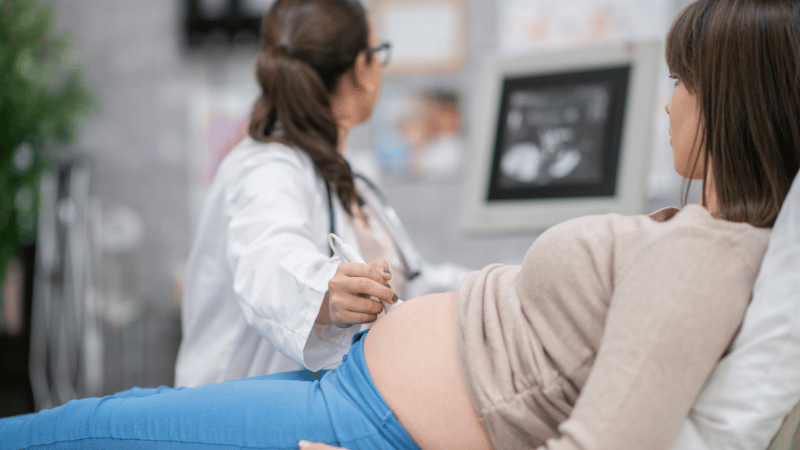
Serial Ultrasound Tracking: High-resolution obstetric ultrasound is the primary, safest tool used to measure fibroid dimensions, evaluate structural changes, and check the fibroid’s distance from the placenta and cervix while monitoring fetal growth.
Active Symptom Evaluation: At each visit, your OB-GYN will evaluate for signs of severe cramping, pelvic pressure, vaginal bleeding, or focal tenderness that could indicate fibroid degeneration or increased uterine muscle irritability.
Advanced MRI Scans: In complex cases where ultrasound imaging is obscured by uterine positioning or body habitus, a non-contrast pelvic MRI provides clear visualization of fibroid boundaries relative to the cervical canal and placental attachment site.
Delivery & Labor Planning: If a large intramural or subserosal fibroid blocks the lower uterine segment or cervix, it can prevent the baby from dropping into the birth canal. In these circumstances, your obstetric team will plan ahead for a scheduled cesarean delivery to avoid labor complications.
Important Note: Active fibroid interventions—including surgical myomectomy or non-surgical UFE—are strictly avoided during pregnancy due to safety risks. Management during gestation is purely supportive, and definitive treatments are evaluated either prior to conception or after postpartum recovery.
Planning Ahead: Treating Fibroids Before Pregnancy

While prenatal monitoring ensures safety while expecting, monitoring alone cannot shrink fibroids or prevent painful cramps from recurring. If you are planning to become pregnant and know you have symptomatic fibroids, consulting a fibroid specialist before conceiving allows you to explore proactive, uterus-preserving solutions.
Uterine Fibroid Embolization (UFE) is a minimally invasive, non-surgical outpatient procedure that blocks blood flow to fibroid tumors, causing them to shrink significantly while leaving your surrounding uterine tissue intact. Because UFE cannot be performed during pregnancy, scheduling an evaluation prior to conception offers the broadest range of non-surgical treatment options.
Treatment Option: UFE
Monitoring Helps You Manage Pregnancy. Treatment Shrinks Fibroids.
If you are living with fibroid symptoms and plan to grow your family in the future, consulting a specialist before conceiving provides clarity and peace of mind.
Uterine Fibroid Embolization (UFE) is a minimally invasive, outpatient treatment that preserves your uterus while permanently relieving heavy pressure and severe cramps.
Frequently Asked Questions
- Fibroid Foundation, “Uterine Fibroids and Pregnancy,” fibroidfoundation.org
- UT Southwestern Medical Center, “Can Uterine Fibroids Harm My Pregnancy?,” utswmed.org
- Laughlin-Tommaso, S.K., et al., “Fibroids in Pregnancy: A Growing or Shrinking Issue?” Fertility and Sterility, 2022, fertstert.org
- National Institutes of Health (PMC), “The Rapid Growth of Fibroids During Early Pregnancy,” ncbi.nlm.nih.gov
Medical disclaimer: This content provides medical educational information only. It is not a diagnosis or formal treatment recommendation. Always consult a qualified fibroid specialist or your OB-GYN for personal healthcare evaluations.